Do permanent lights survive Pacific Northwest rain, Gorge wind and ice storms?
Vancouver gets about 39 to 42 inches of rain a year on roughly 150 to 170 days, an inch or two of snow in a normal winter, and, at the mouth of the Gorge, an east wind that has hit 115 mph at Crown Point and pushes 50 to 60 mph gusts into Washougal, Troutdale and Gresham in an ordinary winter storm. Permanent lighting is the product built for that; seasonal strands on clips are the product that comes down in it. The engineering behind that claim:
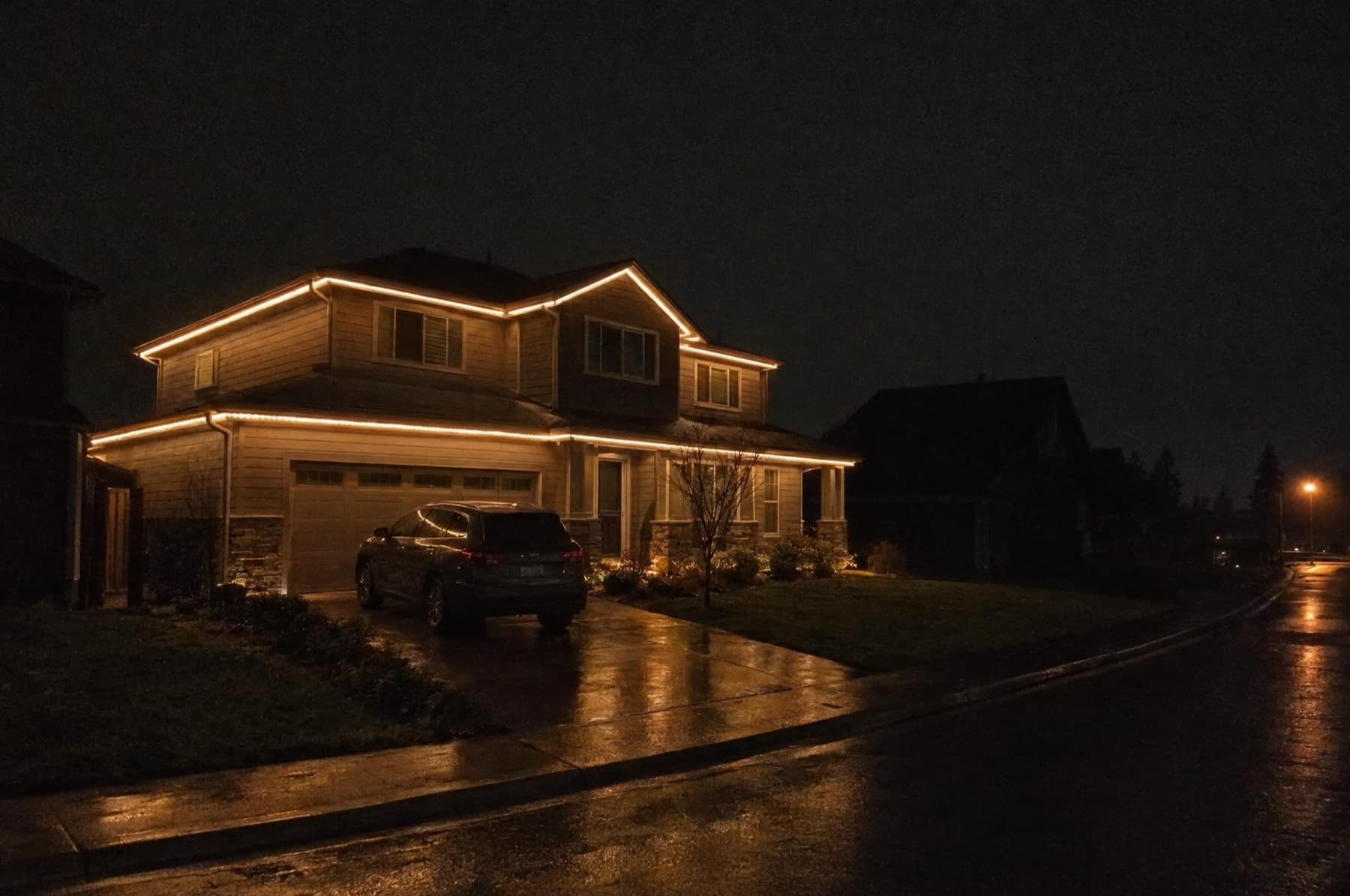
Rain: sealed lights and a low-voltage system
Minleon pebbles and pucks are rated IP66 on the datasheet, which means dust-tight and sealed against powerful water jets. The controller enclosure is IP65 and the common power supplies are IP67, so nothing on the house needs a weather box. The whole system runs at 24 volts DC from a listed Class 2 supply, so a wet connector is a nuisance, not a hazard, and the twist-lock connectors are gasketed.
Rain does one thing to the install schedule: 3M VHB needs a dry surface above about 50°F to bond. We plan bonding for dry hours and leave the strand unloaded for 72 hours while the tape cures.
Wind: nothing hangs, so nothing whips
A seasonal strand fails in wind because it hangs from clips and the cord slaps the fascia until a clip lets go. A track install has no free wire: the strand sits inside a channel that's bonded along its full length and bracketed at every corner and joint, with covers locked over it. There is nothing for the wind to get under.
Local building criteria tell you what the rooflines here are designed for: unincorporated Clark County uses a 135 mph ultimate design wind speed, the City of Vancouver 97 mph with a higher exposure within 1,500 feet of the Columbia, Camas 97 mph, and Gresham assigns 135 mph to the strip along the river with full Gorge exposure. The channel is bonded to a fascia that was built for those numbers; it rides with the house.
Ice and snow
The January 2024 ice storm coated east Portland and Clark County rooflines for days. Ice on a channel dims the line until it melts and does no harm to sealed lights rated to −20°C. The failure mode for seasonal strands in ice is the clip popping under load, which is why we recommend permanent on exposed rooflines in Hockinson and the Gresham hills and seasonal only on sheltered eaves.
On metal roofs, sliding snow passes over lights mounted on the drip edge; we never mount on the roof surface.
Sun and heat
West-facing fascia in Felida and Lake Oswego gets full afternoon sun. VHB is rated far above the temperature a fascia reaches, and the lights' polycarbonate lenses and UV-protected wire are on the datasheet. Bond strength is about the prep: clean, dry, and cured before load.
Moss, gutters and ladders
The channel sits on the fascia below the drip edge, outside the gutter, so gutter cleaning and moss treatment are unaffected. Tell your gutter cleaner the channel is there so ladders are set beside it rather than on it, which is the only way we've seen one damaged.
Packages mentioned
- Pebble Track — $32/ft, controller included
- Magnetic Pebble — $35/ft, controller included